In short
- The basic step has eight counts: three steps and a tap, then the same to the other side.
- You do not shift your weight on count four, so the next step starts with the same foot that only touched the floor.
- The hips move because of the weight transfer and bent knees, not because you push them sideways.
- The most common mistake is putting your weight down on count four, which makes you lose the rhythm.
Everything you see in bachata, from a simple turn to complex combinations at a festival, is built on the basic step. When it is in your body, your brain is free for your partner and the music. When it is not, all you think about is your feet. That is why we start right here.
How bachata is counted
Bachata is danced in eight counts, split into two halves of four. You step on the first three counts, and on the fourth comes the tap.
Then the same on counts 5, 6, 7 and 8, where 8 is again a tap. In the music you will hear that the fourth and eighth counts feel a little different. The bongos and the guitar often accent them.
The side basic step
- Count 1: step to the left with your left foot and shift your full weight onto it. We describe the leader's steps, the follower dances the mirror image and starts with the right foot to the right.
- Count 2: bring your right foot next to your left and shift your weight onto the right.
- Count 3: step to the side with your left foot again and put your weight on the left.
- Count 4: lightly touch the floor with your right foot next to your left, without shifting your weight.
- Counts 5 to 8: the same to the right, starting with your right foot, and on count eight you touch the floor with your left.
The key is that you do not shift your weight on count four. That is why the next step starts with exactly the foot that touched the floor. If you put your weight on it, the right foot is not free for the next step and you easily fall out of rhythm.
Forward and back step
The same rhythm can also be danced in place, forward and back. On 1 the leader steps forward with the left foot, on 2 shifts the weight back onto the right, on 3 brings the left foot next to the right and puts weight on it, and on 4 only touches the floor with the right. On 5 to 8 the same with the right foot back. The follower dances the mirror image and starts with the right foot back. This step is useful in closed hold and on a crowded floor where there is no room to go sideways.
Hips and weight transfer
The hip movement that is so visible in bachata does not come from pushing your hips sideways. It comes from weight transfer and slightly bent knees. When you shift your weight onto a leg and that knee straightens, the hip rises by itself. Try it slowly without music: step, weight, knee, and the hip moves on its own.
The most common beginner mistakes
- Shifting weight on count four. On four you only touch the floor with your foot.
- Steps that are too big. Bachata is danced in small steps, roughly hip width.
- Locked knees. The body stiffens and the hips do not move.
- Looking at the floor. It spoils your posture and your connection with your partner.
- Counting instead of listening. Count at the start, but begin listening to the bongos as soon as you can.
From the step to your first move
Once the step works without thinking, partner leading comes in. The leader offers a movement with the hands and body, the follower reads it (more in our article on leading and following). The first moves are simple turns and changes of direction. How leading and following work is explained on our bachata for beginners page.
How to practise the step to music
Once you have the step without music, put on a slower bachata and just listen first. Find the bongos and try clapping on every count. When you can clap through a whole song without hesitating, add the step in place and only then the side step. Short daily practice helps, five minutes is enough: the step gets into your body faster that way than with one hour once a week.
- Start with a slow song, keep faster traditional bachata for later.
- Count out loud, but after a few rounds try just listening.
- Dance in front of a mirror and watch your step size and bent knees.
Posture and partner hold
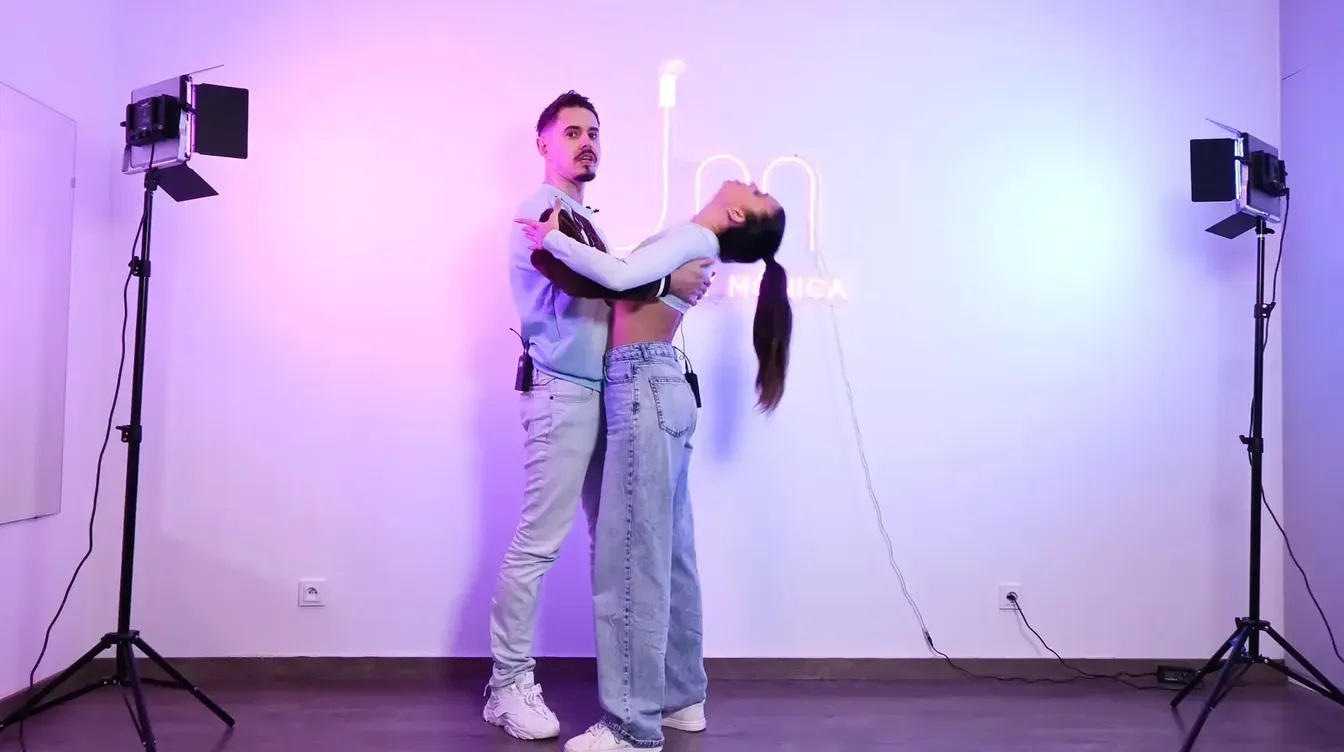
Your body is upright, your shoulders relaxed and your gaze goes to your partner, not to the floor. In open hold partners hold hands, elbows slightly bent and arms with a little tension so that movement passes from one body to the other. In closed hold the leader's right hand is on the partner's shoulder blade and the follower's left hand is on the leader's shoulder. The hold should be firm but not stiff: your partner has to feel where you are leading them, and at the same time must not feel trapped.
First turns and moves for beginners
In a beginner class the first moves are gradually added to the basic step. Typically it is the follower's right turn under the leader's arm, the place change, where partners swap sides, and the leader's turn. All of them are danced in the same rhythm as the basic step, only the direction changes. If the step is in your body, you will manage them within a few classes. More complex combinations follow in the intermediate and advanced classes.
Video or class?
You can learn the step from a video too, for example in our online bachata course on Herohero. In class, though, the teacher sees that you shift your weight on count four or lock your knees, and corrects it before it becomes a habit. When a video is enough and when it is not is covered in our article on online bachata or classes.
Questions people ask
What is the bachata basic step?
Which count is the tap in bachata?
How do the hips move in bachata?
How can I practise the bachata basic step at home?
What are the first moves in bachata?
How long does it take to learn the bachata basic step?


Written by
Jorge and Mónica are professional dancers who have taught bachata for more than fifteen years. As international artists they have taught from Tokyo and Singapore to Melbourne and Spain; in Prague they run Jorge y Mónica Academy and Bachata Czech Republic Festival.